Carrie Pickles (later Pollard) 1904-1984
Explore the remarkable life of Carrie Pickles, a pioneering British gymnast who won a bronze medal at the 1928 Olympic Games. Carrie made history as the first woman to both compete in a medal-winning Olympic team and later coach Olympic gymnasts. Read about her dedicated career, community coaching, and lasting legacy in British gymnastics.
Early life and education
Edith Carrie Pickles (always known as ‘Carrie’ was the second of six children, born in the village of Wilsden near Bradford in 1904. Her parents ran a grocery business.
Carrie attended Wilsden Council School, followed by Belle Vue Girls’ School in Bradford, a good School, but she had to leave the house at 7.30a.m. to get there.
Bradford gymnastics club
Carrie did not have any special favours or achievements in her general education, but it is clear that she was very interested in gymnastics and the teaching of it.
When the family moved to Shipley she pestered her father to allow her to join Bradford Gymnastics Club, although it was a complicated and lengthy journey to get there1. This was the leading gymnastics club in the district, founded in 1909, and was successful in the English teams championship on three occasions2. Carrie showed initiative in choosing to join it and attending the Club persistently.
Career as a secretary and gymnastic prizes
The Shipley Times and Express3 also reported that even before leaving school Carrie wanted to teach gymnastics. But ‘her father needed an assistant’ for his grocer’s business in Saltaire, so she had to stay at home and help out.
Carrie combined this with starting at a commercial school, learning shorthand typing, and for ten years working at the Wool Textile Suppliers, in Lidget Green, Bradford.
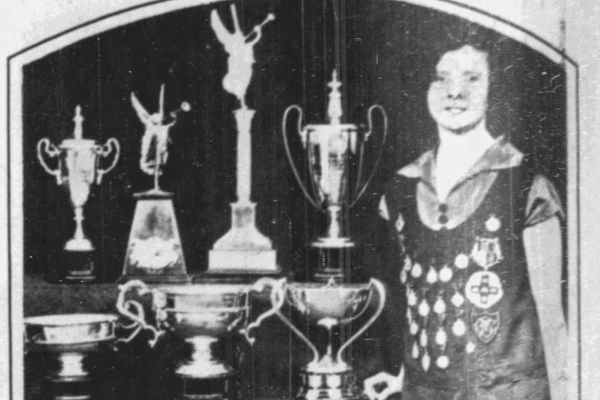
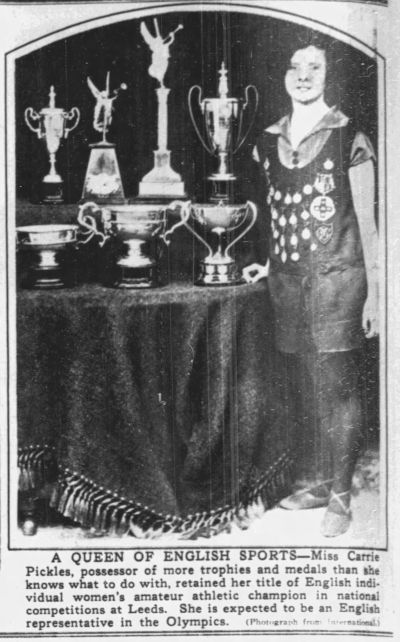
Carrie continued to attend the Bradford Gymnastics Club and won the championship for individual gymnastic performance in 1924, 1925 and 1926. She won the Northern Counties Gymnastic Cup at its inception in 1928.
Chosen for the Olympic Games
Carrie was coached by Edwin Hirst who was the coach for the women’s team at the Olympics, 1928. For the first time in 1928 Britain was going to send a team of women gymnasts to the Olympic Games.
There was a very strong contingent from West Yorkshire and you would think that this would be a cause of much celebration. However, Ann Broadbent, Carrie’s team mate said, ‘We were pleased to be chosen and looked forward to going, but I don’t think anyone was specially thrilled’. At least one of the competitors had to take a week’s holiday to be able to go at all. This was not the age of sporting celebrities.
Experience of the Olympics
Carrie commented ‘Gymnastics was merely a hobby with us then. In competition we wore divided skirts and a blouse, long woolly stockings and gym shoes and a hair net so that your hair was not flying about. Nowadays in a leotard you are as free as the air.’
In spite of all this the Shipley Times and Express4 reported that the holiday in Holland was a wonderful experience. It is very probable that none of the women’s team members had been abroad before.
The women’s team came third out of five teams so gained the bronze medal. However, the team could not afford to stay for another night, so the medal was sent to them afterwards.
Carrie gained a personal honour, as she was chosen to represent all the women gymnasts to Queen Wilhelmina of the Netherlands. This was not entirely enjoyable, as Carrie had to stand up for seven hours while the Queen and her daughters tried to talk to all the representatives. She could not sit until the Queen did.
Carrie’s retirement from competition, and her coaching and teaching
After the Olympic Games, Carrie retired from competition in 1930. She had a busy life of coaching and teaching, as well as continuing, at least at first, with her secretarial day job. And in 1933 she married C. Malcolm Pollard of Shipley.
Carrie coached the Bingley Gymnastics Club and in 1929 started ‘The Saltaire Ladies Gymnastics Club’. It was here that Carrie coached a succession of gymnasts who represented Britain in the Olympic Games for over twenty years. Carrie herself was the first woman to have taken part in a winning team at the Olympics (1928) and to have gone on to coach a team for the Olympic Games (1948 and 1952) .
The Saltaire Ladies Gymnastics Club and the community
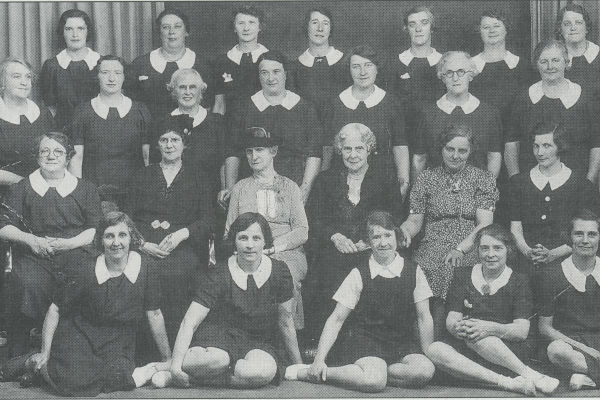
The Club did not only train expert athletes. It held a meeting in September 19445 where it was said that the Club had carried on throughout the war ‘under the expert leadership of Mrs. Carrie Pollard, ex-England gym champion’. Now they were looking towards a campaign to recruit new members so as to have a live organisation ready for the cessation of hostilities. ‘Any lady who wishes to join will be very welcome to come for a fee of 1/- per session’. The Club was not only for elite athletes, but welcomed anyone from the community who wanted to keep fit.
Carrie took these responsibilities seriously. The Shipley Times and Express is full of descriptions of dancing events and shows done by Carrie’s pupils. This included her own daughters, Jill and Jan, when they were small. In 1960 her older daughter, Jill Pollard competed in the Rome Olympic Games.
A teaching certificate at a mature age
In the nineteen fifties Carrie went to get a teaching certificate at Loughborough College. This is not surprising when you remember that her first ambition had been to be a teacher of gymnastics. Probably there were some financial incentives as well.
This was followed by even greater activity. Carrie went on to teach at schools in Bradford and Keighley. She taught keep-fit three nights a week, and also two nights and Saturdays with Saltaire Gymnastics Club. She eventually taught gymnastics at Leeds Athletic Institute on a Sunday.
Carrie’s death and her commemoration by a blue plaque
Carrie eventually moved to her daughter’s home in Scotland and died there on 18 March 1984.
She is commemorated by a blue plaque on the house where she was born in Wilsden. This is a very well deserved blue plaque when you consider how consistently she pursued the sport she was interested in, and showed great dedication until she won the highest honours. After this she did her best to pass on that skill to others.
Pauline Ford, July 2026.
Discover more working women associated with Saltaire
Carrie appears in our online exhibition of Working women of Saltaire
Acknowledgements
Many thanks to the British Newspaper Archive
Carrie Pickles, by Meg Warren with Jill Livingstone nee Pollard
Top image: Carrie Pickles with some of her trophies in 1928. Image credit: International News Service, Public domain, via Wikimedia Commons