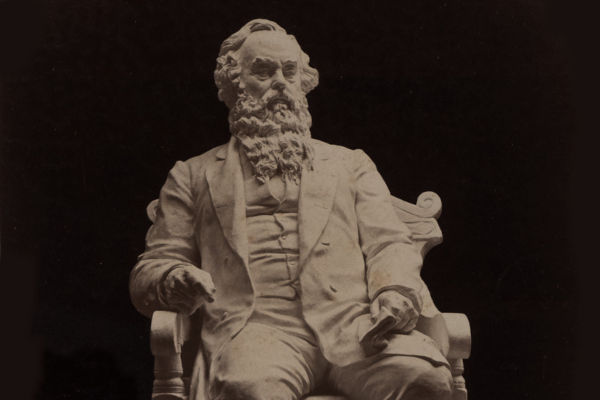
Sir Titus Salt died 150 years ago this year. In an earlier snippet we described his very public funeral. Here you can read more about some of the civic and public acclaim for Sir Titus in his later life and after his death.
Statues of Sir Titus
Prior to Sir Titus’s death, public subscriptions had helped build a prominent statue of him. The statue first stood in Bradford’s Town Hall Square. The Duke of Devonshire unveiled the statue in 1874, amid lavish celebrations.
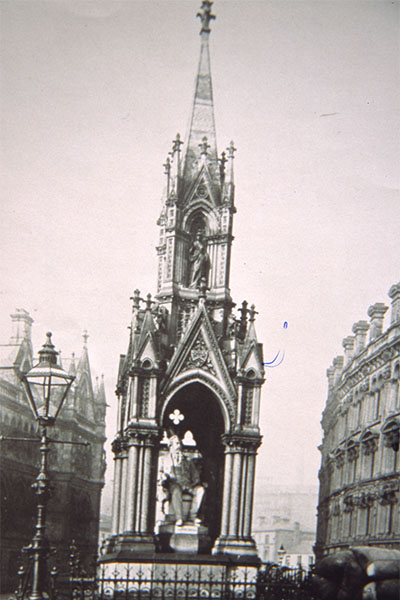
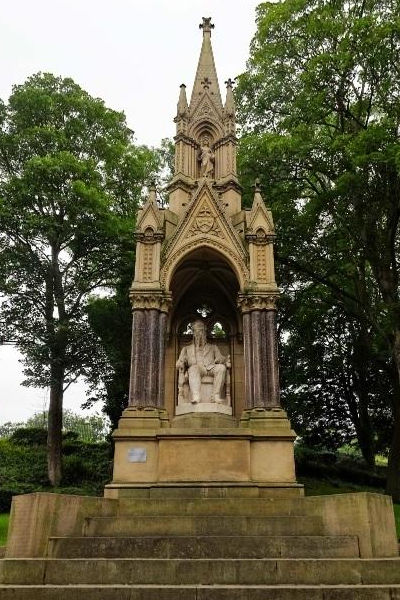
The marble statue was made by the leading sculptor John Adams Acton. It shows Sir Titus seated, holding a scroll of the plans of Saltaire. The canopy was designed by the architects of Saltaire, Lockwood & Mawson. It features Sir Titus’s coat of arms, along with symbols representing Justice, Prudence, Temperance and Charity. In 1896 traffic congestion in central Bradford forced its relocation to Lister Park in Bradford.
Reputedly, when Sir Titus found out about plans for the statue, he joked: “So they wish to make me into a pillar of salt.” At the unveiling, the Chairman of the committee said:
we are met to do honour to one of Bradford’s worthiest citizens…whose modesty of disposition and strength of character are worthy of imitation by the rising business men of the town.
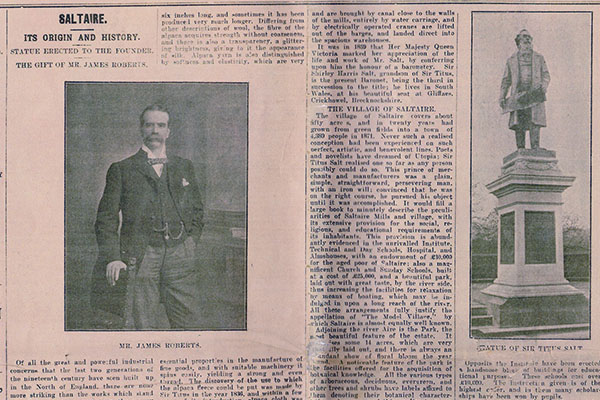
Another statue of Sir Titus now stands in Roberts Park in Saltaire. This statue was commissioned in 1903 by James Roberts, a later owner of Salts Mill and Saltaire, to mark 50 years since the mill was opened.
After the funeral
Following the funeral of Sir Titus on 5 January 1877, the community continued to express its respect and mourning in several ways. The day after the funeral, the coffin was moved from the front of the Communion rail in Saltaire Congregational Church to the family mausoleum. The mausoleum was opened for public viewing on 8 January. This allowed residents and admirers to pay their final respects in a dignified setting.
On Sunday, 7 January, funeral sermons were delivered at various places of worship throughout Bradford and the surrounding area, drawing large congregations. These services reflected the widespread impact of Sir Titus’s life and the collective sense of loss felt by the community.
The scale of the funeral and the public’s response were unprecedented in the Bradford district. Extensive preparations had been made, including the removal of over 3,000 tons of snow and the employment of 250 men to clean the streets in advance of the procession. Businesses, banks, and mills had closed or suspended operations as a mark of respect, and the event was marked by a sense of solemnity and unity.
The days following the funeral were characterized by continued remembrance and public acknowledgment of Sir Titus’s contributions. The opening of the mausoleum to the public and the widespread participation in memorial services underscored the deep admiration and gratitude held for him by people from all walks of life.