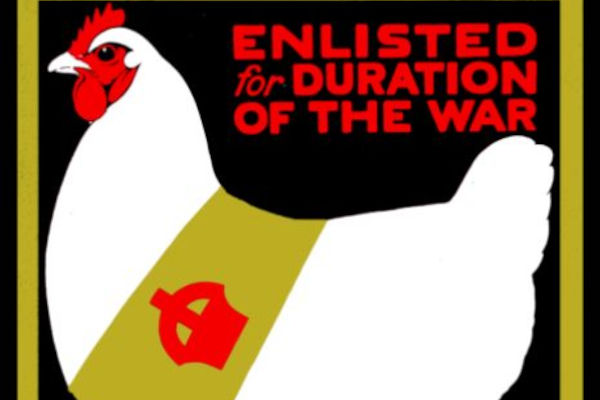
The National Egg Collection for the Wounded
Easter, a time of giving and receiving eggs, chocolate eggs. But in the 1900s eggs of a different kind were being given and received. According to the Shipley Times and Express dated 9 April 1936, Sir Titus Salt’s Hospital in Saltaire received a delivery of 7560 eggs – hens’ eggs, collected and donated mostly by local school children. It was intended that the eggs would meet the needs of the hospital’s patients for the coming year. But where did all this start?
Eggs on active service
Eggs are nutritious and ideal for people who are sick or injured. During World War 1 people across Britain were encouraged to stop eating eggs and instead donate them for dispatch to hospitals in the UK, France and Belgium where wounded soldiers were being treated or convalescing. This was known as the National Egg Collection for the Wounded.
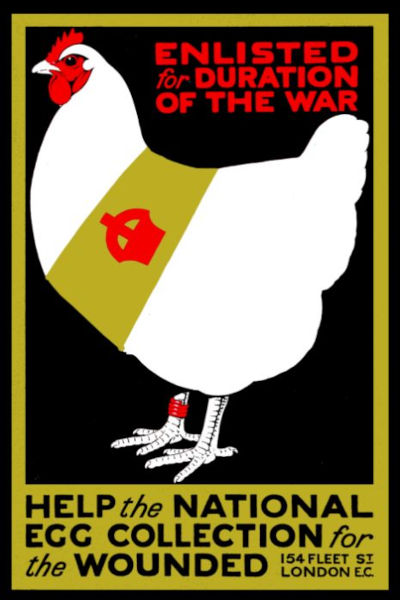
The magazine Poultry World initiated the scheme. The magazine had run an annual egg collection scheme, Hospital Egg Week, for some years. However, in August 1914 the editor of the magazine proposed a national scheme. “Every British hen should be on active service” was the slogan chosen and it appeared on propaganda posters across the country.
The original target was to collect 20,000 eggs. The scheme was so successful that at its peak in the week between 16 and 23 August 2015 the collection reached 1,030,380 eggs, not including those sent directly to hospitals in the UK.
40 million eggs collected
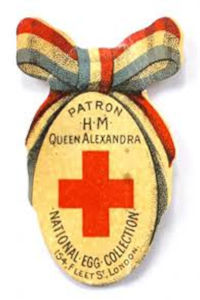
Queen Alexandra was the scheme’s patron. Warehousing was provided in London free of charge, initially by the department store, Harrods. Labels and boxes were supplied and railway transport provided for free, allowing the eggs to be delivered to France in 3 days. A huge number of people across the country were involved. Donors were encouraged to sign their eggs and write their name, address and a short message on the boxes. There are examples in the press of letters received from soldiers at the front thanking contributors for their donation.
As the war progressed the scheme started to falter as food production at home suffered. Feed for hens became more expensive resulting in a reduction in the number of hens being kept and more eggs being retained for home consumption. In February 1918 the Government issued the Egg (Restriction) Order limiting the use of eggs to human consumption or breeding.
However, over the course of the war over 40 million eggs were collected of which 32 million were sent to hospitals in France and Belgium.
But this is not the end of the story…
Easter egg collections
After the war egg collection in the Shipley district, and quite possibly nationally, continued but was limited to the period leading up to Easter. Various local bodies were involved, for example the Shipley Chamber of Trade, the Salvation Army and the Rotary Club.
In 1938 the Shipley Times and Express reported that 18090 eggs had been collected locally, largely through schools. Sir Titus Salt’s Hospital was the major beneficiary of these eggs, but others were Bradford Royal Infirmary, The Bradford Royal Eye and Ear Hospital and the Bradford Children’s Hospital.
There is evidence in the local press that the collections continued up to 1941 when a scarcity of eggs during World War Two meant the end of the collections. However, people were still encouraged to save eggs when they could and donate them to worthy causes.
What to do with 7560 eggs?
“Knock, knock – egg delivery Matron”. What on earth do you do with 7560 eggs!! Knowing Hannah Mitchell, who was the Matron at Sir Titus Salt’s Hospital during the early 1900s, she would have arranged a rota of local women, working parties in fact, to help with the processing of the eggs. They were intended to meet the needs of the hospital for a year so I can only assume that they were pickled. Here is a recipe.
Classic Pickled Eggs (courtesy of homemadeandyummy.com)
Ingredients: (the figures in italic relate to volumes for dealing with 7560 eggs)
12 (7560) large eggs (hard boiled and peeled)
- 4 (2520) cups white vinegar
- 11/2 (945) cups water
- 11/2 (945) cups coarse sea salt
- 1 (630) tablespoon pickling spice
Instructions
- Sterilise a large mouth jar (s)
- In a pot combine the vinegar, water, salt and pickling spice
- Bring to a boil, reduce heat and simmer for 5 minutes. Remove from heat and let cool slightly
- Place peeled eggs into the sterilised jar
- Pour brine over the eggs
- Seal jar. Leave for an hour and then place in fridge
- Let eggs sit in brine for at least 3 days (or 365 days) before eating
ENJOY
Caroline Perry 2026
SOURCES
Various articles in Shipley Times and Express and Bradford Observer. Available at: www.britishnewspaperarchive.co.uk
The National Egg Collection in Egham. Available at: www.eghammuseum.org
Egg Collection Scheme. Available at: www.hedon.gov.uk